

Shop Our Online StoreVISIT OUR ONLINE STORE for a broad array of high-quality colon cleansing and enema equipment, nutritional supplements, and detoxification products, as well as supporting educational articles on home colon cleansing, constipation, and much more!


Sorry, no results found on this keyword.
Sorry, no results found.

November 21, 2018

Hopeful Possibilities of Preventing or Slowing Bone Loss through Probiotics

Bone fractures due to osteoporosis very often have tragic consequences, with complications from hip fractures causing a mortality rate of 24%-30% during the first year following injury, and an almost 50% rate of permanent disability (Burge et al., 2007). Unfortunately the high cost and challenging side effects of the major osteoporosis drugs currently on the market lead to most osteoporosis cases going untreated or undertreated. Therefore there is an urgent need to find less expensive, effective, and well-tolerated strategies not only for treating osteoporosis after its onset, but in particular for preventing or slowing initial bone loss in the aging population.

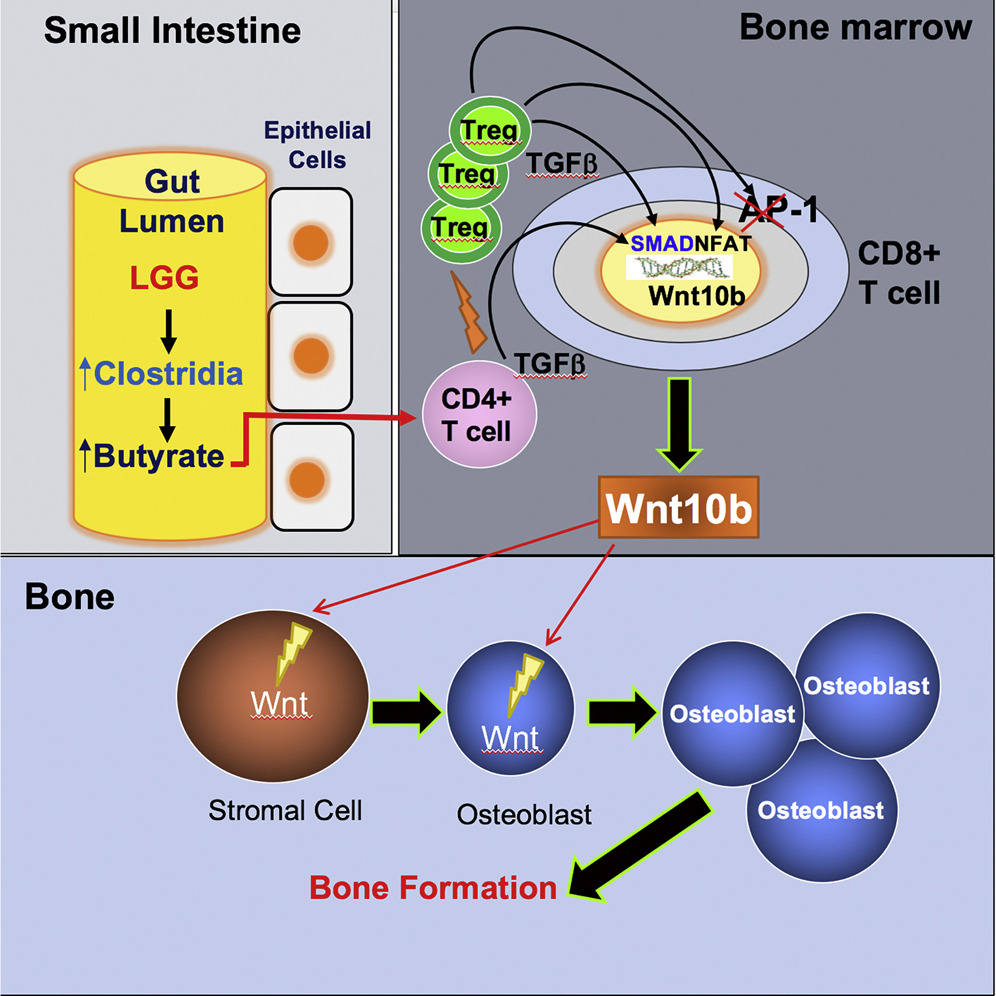
Nutritional supplementation with probiotics (viable microorganisms that provide a health benefit when ingested in adequate quantities) may represent one hopeful strategy in fighting bone loss, which can begin as early as age 40. A recent study published in the journal Immunity tested the ability of the probiotic Lactobacillus rhamnosus GG (LGG) to enhance bone growth. The study, using laboratory mice, revealed that this probiotic stimulated the growth of gut bacteria that produce a particular metabolite called butyrate. Butyrate, in turn, prompted T cells in bone marrow to produce a protein called Wnt10b, which is vital for bone growth (see graphical abstract). States the study's senior author, Roberto Pacifici: "We were surprised by the potency of the gut microbiome in regulating bone and by the complexity of the mechanism of action of probiotics."
Human bone is not a static structure. Bone is made up of living tissue that is continuously being broken down and remade into new bone by the body. This natural rebuilding cycle is robust typically only through one's 20s. By around age 30, the body stops increasing bone mass, and beyond age 40, more bone is often being broken down than is being replaced. This slowdown tends to be more pronounced in women than men, and therefore older women are generally at higher risk of developing osteoporosis than men.

Pacifici explains that his team's bone growth findings still need to be validated in human studies. If such studies are successful, this could lead to a promising and more affordable protocol through targeted probiotics for both optimizing skeletal development in young people and helping to prevent osteoporosis in older people.

I recommend Ortho Molecular's Ortho Biotic oral supplement as a trusted source of the Lactobacillus rhamnosus probiotic which was tested in this study. More broadly, I highly recommend this product's overall proprietary blend of probiotics to many of my clients, especially those with digestive difficulties and those using enemas as part of a colon cleanse regimen. Ortho Biotic has guaranteed potency at ingestion, and has been scientifically formulated for room temperature storage. No is refrigeration needed.

BUY ORTHO BIOTIC SUPPLEMENT


Read Full Study:
The Microbial Metabolite Butyrate Stimulates Bone Formation via T Regulatory Cell-Mediated Regulation of WNT10B Expression


Labels: , , , , , ,


November 19, 2010

First Things First: Eat Breakfast

by Stephanie Carnes
OHN Contributor


Upon waking, your body needs nutrients. During a good night’s sleep, your body has used up a rich supply of nutrients, helping it recover from the work of the previous day. Also, it has used nutrients to heal and rejuvenate stressed or damaged body parts. If you don’t take steps to replenish those expended nutrients, the body will resort to utilizing its reserved store of nutrients. You don’t want your body to have to run your day-to-day activities on those reserves. You want those reserves for times of crisis. You want those reserves for your own protection when others around you are sick, and of course, for graceful aging.

A useful analogy that we are all familiar with regarding our body depleting its reserves is osteoporosis. Calcium, an essential mineral for many bodily functions, is stolen from the bones when the body becomes too acidic. An acidic body is caused by many factors, including not eating breakfast, staying up too late, and eating processed sugar and flour. When the body doesn’t have the resources to counteract stressors, it steals from within itself to bring about homeostasis. Unfortunately, this imbalance often doesn’t show up for many years, until one actually has osteoporosis.

One of the most important things you can do for your health is to think about what you are eating and how it affects the balance of your blood sugar. Without breakfast, you start the day in a state of low blood sugar. Low blood sugar is always hard on the body. It can cause premature aging and adrenal exhaustion, and it pushes people towards binge eating of high carbohydrate foods. Binge eating of carbohydrates sends a person’s blood sugar into the too-high range. The subsequent effect is equivalent to riding a roller coaster all day long. The discipline of eating breakfast helps you eat better the rest of the day.

When we take eating seriously, we ingest a higher quality, and more appropriate quantity, of necessary nutrients.

Essential Guideline

Eat breakfast within a half-hour of waking. Eating breakfast is a key part of the OHC plan! Your breakfast should consist of ¼ to one whole piece of fruit, followed 5-10 minutes later by non-starchy vegetables, fat, and protein. Not eating breakfast is a major factor in jeopardizing health.


SOURCE: Ten Days to Optimal Health (Amelong 2006)


Labels: , ,


November 15, 2010

Know Your Limits: Coffee, Soda and Alcohol

by Stephanie Carnes
OHN Contributor


Coffee can be very hard on your body. It makes the body overly acidic, kills the healthy microbes in your gut, and tends to throw your blood sugar off balance. An addiction to this beverage is a sign that your adrenal glands are already exhausted, and coffee drains those glands even more. All of these imbalances make it hard for the body to truly rest, and they make it hard for the individual to know what their limits are.

Many people find that coffee is almost impossible to give up because it is one of their most important and essential daily rituals. People need rituals that allow them to feel that life is good and that they can handle the chores of day-to-day life. Unfortunately, for many this contentment comes with their daily cup of coffee. If this is the case with you, you will want to find a coffee substitute like green or herbal tea, at least for a period of time. Go out and get yourself a lot of different teas, experiment and have fun!

Besides the excess sugar or NutraSweet found in soda, studies demonstrate that phosphorus, a frequent ingredient of soda, can deplete bones of calcium. Phosphorus, which occurs naturally in some foods and is used as an additive in many others, appears to weaken bones by promoting the loss of calcium throughout the entire body. With less calcium available, the bones suffer by becoming more porous and prone to fractures and osteoporosis.

Additionally, alcohol contains elements of fermentation that can be dangerously stressful and damaging to the liver, which is our major filter of toxins as well as the major organ of digestion. Alcohol also damages glandular/immune organs, connective tissue and the nervous system. For those of you who find it hard to give up alcohol, twelve step programs such as Alcoholics Anonymous are welcoming and have healing tools that do work. Your life will be greatly enriched by doing the emotional and spiritual work of the steps.

You may be putting undue strain on your digestive and detoxification systems if you are over-consuming these beverages. It is recommended to eliminate them from your diet all together if you have chosen to embark on the Optimal Health Center detoxification plan.

For more information on Kristina Amelong’s Step-By-Step Guide to Nutritional Therapy and Cleansing, please view the source below.


SOURCE: Ten Days to Optimal Health (Amelong 2006)

Labels: , , , , ,


November 8, 2010

How Raw Milk Can Help

by Stephanie Carnes
OHN Contributor


Raw dairy foods from grass-fed cows may be our healthiest source of nourishment at this point in history. It is high in enzymes, vitamin A, vitamin D, and Activator X, along with many other nutrients. Even if you have an excellent diet, if you don’t have these nutrients in high enough quantity, you will not absorb your fats, your minerals, or your water-soluble vitamins.


Here are three ways raw milk can help you gain optimal health:
  1. Sufficient vitamin D is lacking in commercial dairy products and needed for proper calcium absorption. Additionally, sugar consumption and stress can both pull calcium from the bones. The best sources of usable calcium are found in raw dairy products. 
  2. Also found in raw milk is lactose, or milk sugar. This is the most important carbohydrate for the colon flora. Just as yogurt or kefir-making bacteria thrive off the lactose in milk, so do our own internal bacteria thrive with lactose. If you really want to keep your intestine full of healthy bacteria, drink at least one cup daily of raw milk from pasture-raised cows or goats.
  3. You cannot be healthy without an adequate dietary intake of lipase, the fat-splitting enzyme, which assures that the fats and oils can be taken into the cells. Raw milk products are a tasty and easy way to ingest large quantities of lipase.
Microbiologist Lee Dexter says that raw milk not only is safe but may be healthier than pasteurized milk. The former USDA employee sells raw goat’s milk in Texas, where it is legal. Lee Dexter has reviewed numerous cases worldwide and has written a lengthy report on raw milk. She said most comments made by epidemiologists and public health officials on the dangers of raw milk are opinions and “are not based on scientific fact.” She said statistics from the Centers for Disease Control and Prevention clearly show that “people drinking pasteurized milk are four times more likely to contract a food-borne illness” than those who drink raw milk. Dexter said “challenge tests,” in which raw milk was inoculated with pathogens and examined later, showed that the pathogens were destroyed. “Raw milk contains its own immune system,” she said.

When discussing the healthfulness of raw milk, it is crucial that the farmer assures the health of the cow. Historically, this has not been done, which is why raw milk has gotten such a bad name. However, raw milk is a safe food. It has been commercially available in California for decades with not a single adverse affect.

For more info check out this Raw Milk Resource Guide.

SOURCE: Ten Days to Optimal Health (Amelong 2006)

Labels: , , , , ,


Shop for Enema Equipment, Detoxification Products, and More


RETURN TO TOP

DISCLAIMER: This blog and any linked material are presented for informational purposes only and are not a substitute for medical advice, diagnosis, or prescribing from a licensed healthcare professional. Nothing contained in or accessible from this blog should be considered a medical diagnosis, promise of benefits, claim of cure, legal warranty, or guarantee of results to be achieved. When you purchase any product from Optimal Health Network, Inc., we must presume that it is for personal use under the direct supervision of your medical doctor. Never disregard medical advice or delay in seeking it because of something you have read on this blog or in any linked material. Consult with a licensed healthcare professional before altering or discontinuing any current medications, treatment, or care, or starting any diet, exercise, cleansing, or supplementation program, or if you have or suspect you might have a health condition that requires medical attention. The United States Food and Drug Administration has not evaluated any statement, claim, or representation made on this blog.

© Optimal Health Network, Inc.
All Rights Reserved
Development by Zumavi Design